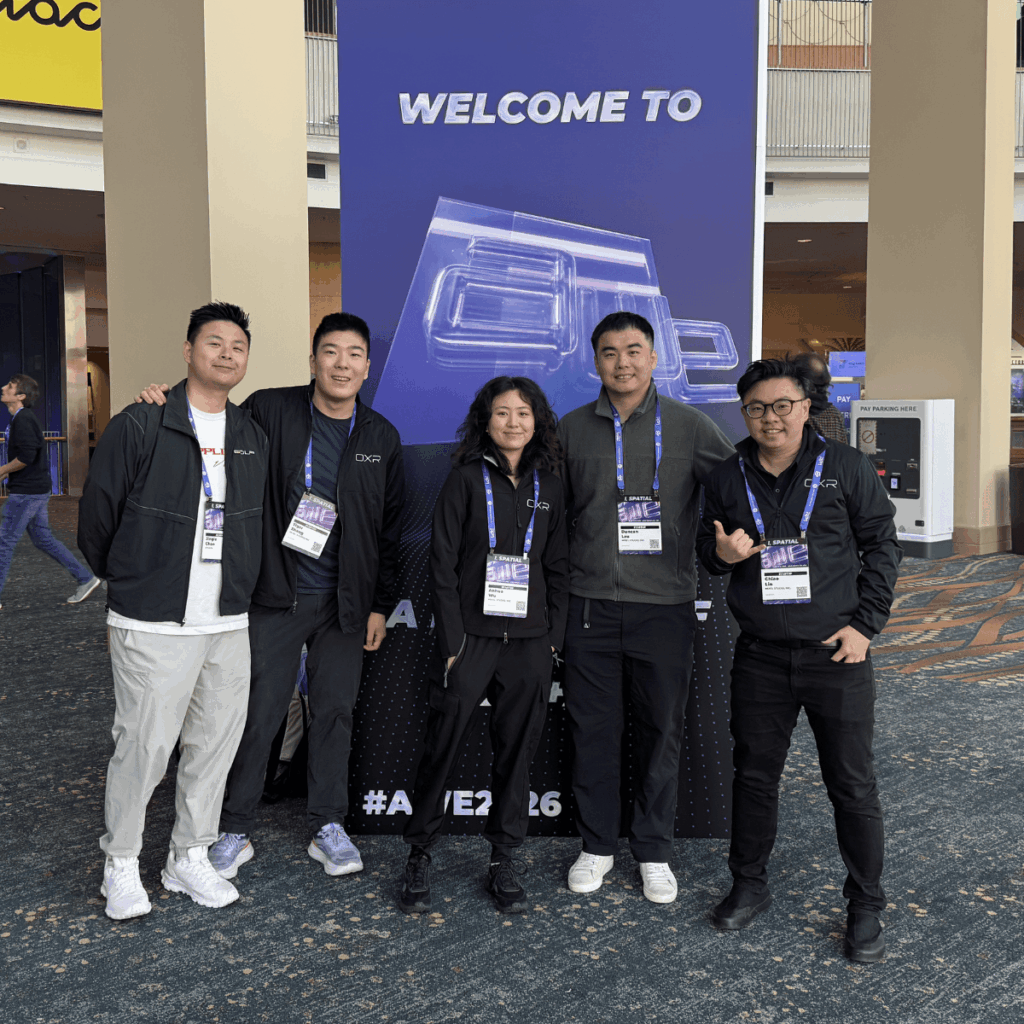
Long Beach, CA — June 21, 2026 — After a year of development, Mixel Studio introduced OXR to the public at AWE, one of the world’s largest XR industry gatherings, held June 15–19 in Long Beach. Presenting from Startup Table S16, the team showcased a platform built on a single premise: spatial experiences should be as simple to create, present, and join as a slide deck or a video call.
OXR lets users launch spatial sessions instantly, organize 3D scenes like slides, embed multimedia, and guide an audience across devices. Rather than requiring every participant to wear a headset or depend on a custom build, OXR brings audiences together from browsers, mobile devices, and XR headsets — all synchronized in real time.
Selected for the AWE Media Walkthrough
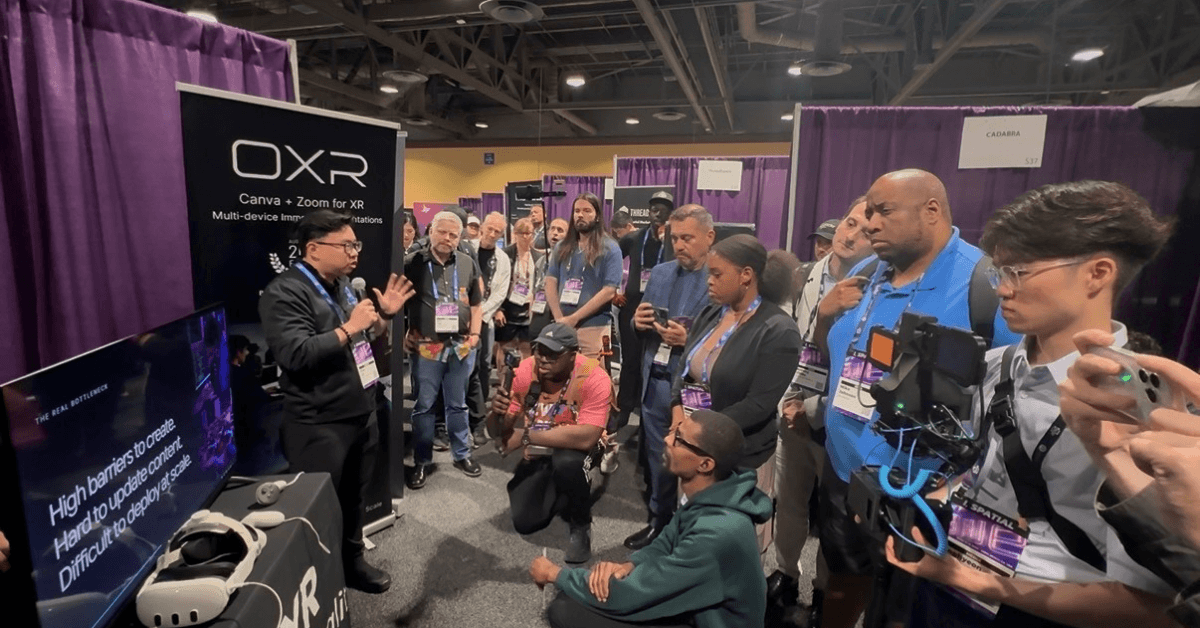
A defining moment of the week came when OXR was chosen for the AWE Media Walkthrough. Ethan Rasiel, PR Director at AWE, led more than 20 members of the press to the OXR booth for a firsthand look.
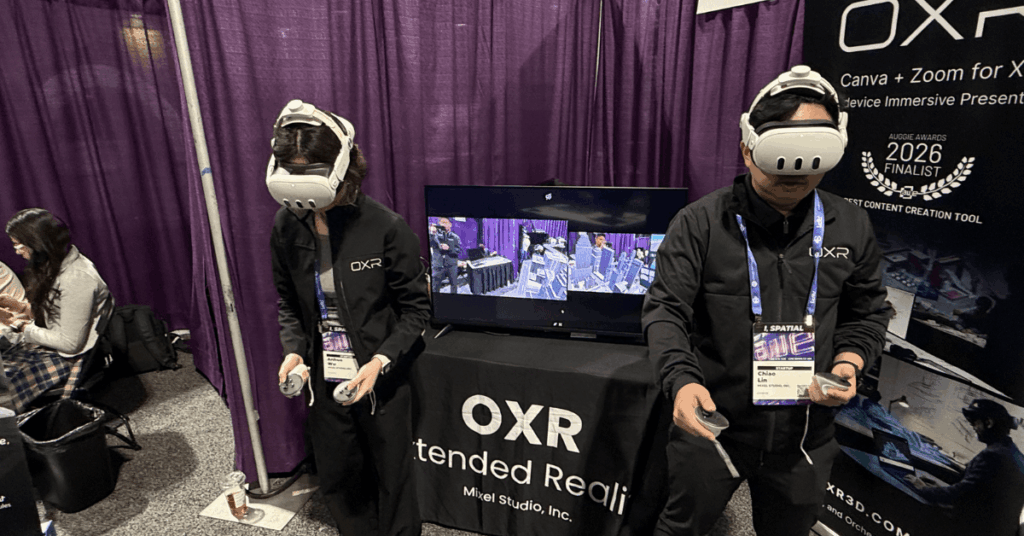
The demo centered on OXR’s XR Audience Join experience, in which headset users entered a live spatial session and saw the same content, presenter guidance, and annotations update in real time. The value was immediately apparent: a host can walk an audience through a 3D environment, explain spatial concepts, and control the flow of a presentation without forcing everyone into identical hardware.
The team demonstrated practical applications — reviewing city zoning and urban planning, comparing room designs, and stepping an audience directly into a shared spatial environment. Instead of relying on static images or flat slides, presenters can place people inside the scene and lead the conversation around the actual 3D content.
Removing the Friction from XR
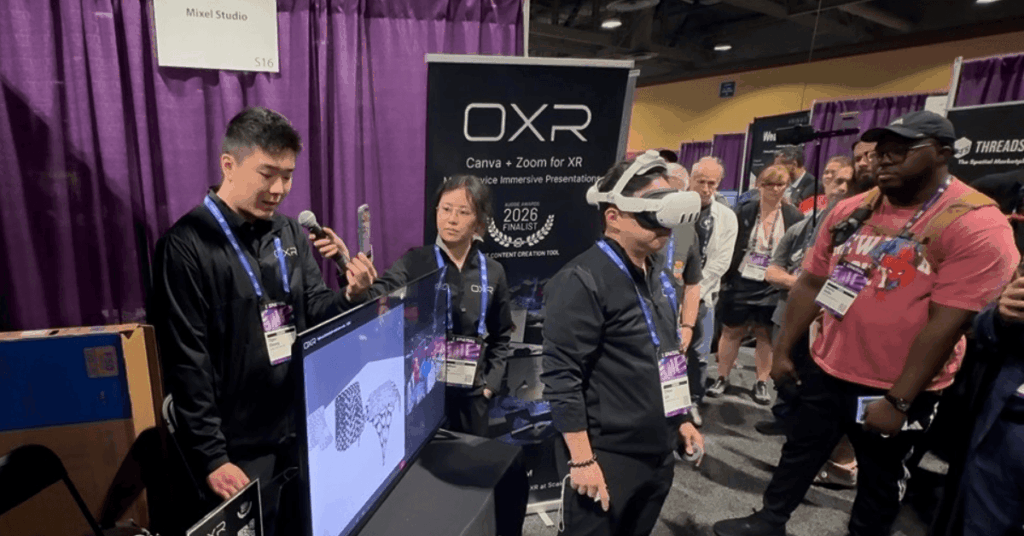
The team also highlighted OXR’s browser-led facilitator control, which allows a presenter to run a spatial session entirely from a browser without remaining in a headset. For educators, sales teams, designers, and facilitators, this is a meaningful shift: XR becomes something they can confidently manage, guide, and present with.
The response from the press was enthusiastic, with audible reactions throughout the demo. For the team, that response signaled something important — people grasped the experience instantly. OXR was not merely demonstrating a technical feature; it was demonstrating a simpler way to present and share spatial content.
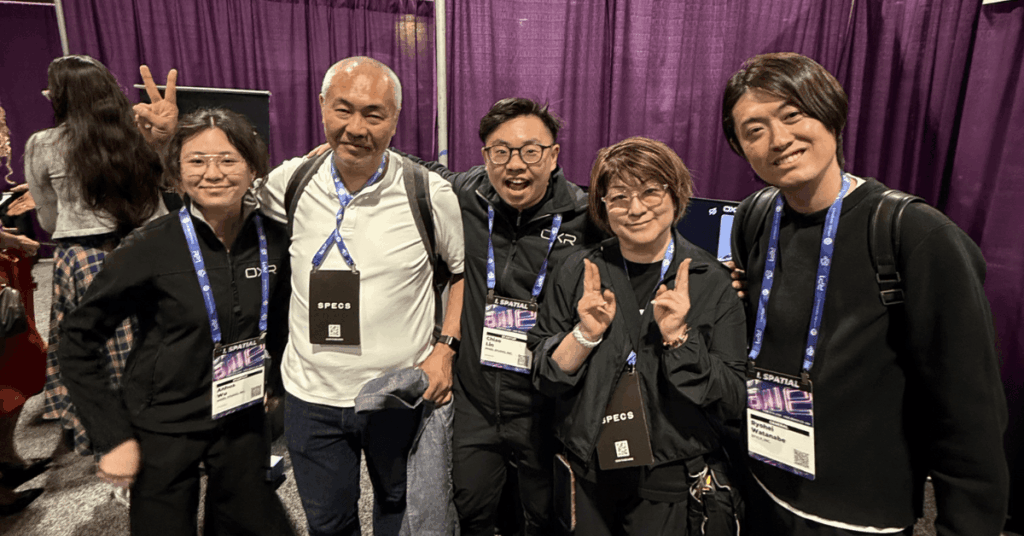
Mixel Studio was also honored to welcome Masahiro Yamaguchi, Co-Founder and CEO of STYLY, and Ako Shiraogawa, Business Development at STYLY, to the booth. As leaders with deep expertise in the XR field, their feedback carried particular weight. “This is very good design, making it easy to access. Great job,” Yamaguchi said — a comment that reflects exactly what the platform is built to achieve: lowering the barrier to XR so more people can use it, present with it, and scale it.
Built for Real-World Conditions
One of the most validating aspects of the showcase was OXR’s stability over the conference’s unreliable Wi-Fi. Anyone who has demonstrated live technology at a major event understands how unforgiving those conditions can be. OXR kept multiple devices synchronized on minimal bandwidth, demonstrating the strength of the underlying architecture.
That reliability matters. For spatial presentations to take hold in classrooms, product demos, design reviews, museums, trade shows, and enterprise workflows, they must perform well beyond ideal lab conditions — easy to launch, easy to join, and stable enough for real audiences. AWE offered a high-pressure proving ground, and OXR delivered.
Opening the OXR Beta Program
Throughout the week, attendees approached the team to discuss B2B collaborations and use cases spanning education, immersive storytelling, and real estate sales. The conversations reinforced a core conviction: as spatial content grows more important, many are searching for a solution that is easy to access and easy to deploy.
With that in mind, Mixel Studio is officially opening the OXR Beta Program. The vision is straightforward — spatial experiences should be as easy to join as a video call and as easy to organize as a slide deck, across browsers, XR headsets, and the AR glasses to come.
Those interested in building, presenting, or deploying spatial experiences can now sign up for the Beta Program and receive an access code to begin creating with OXR.